

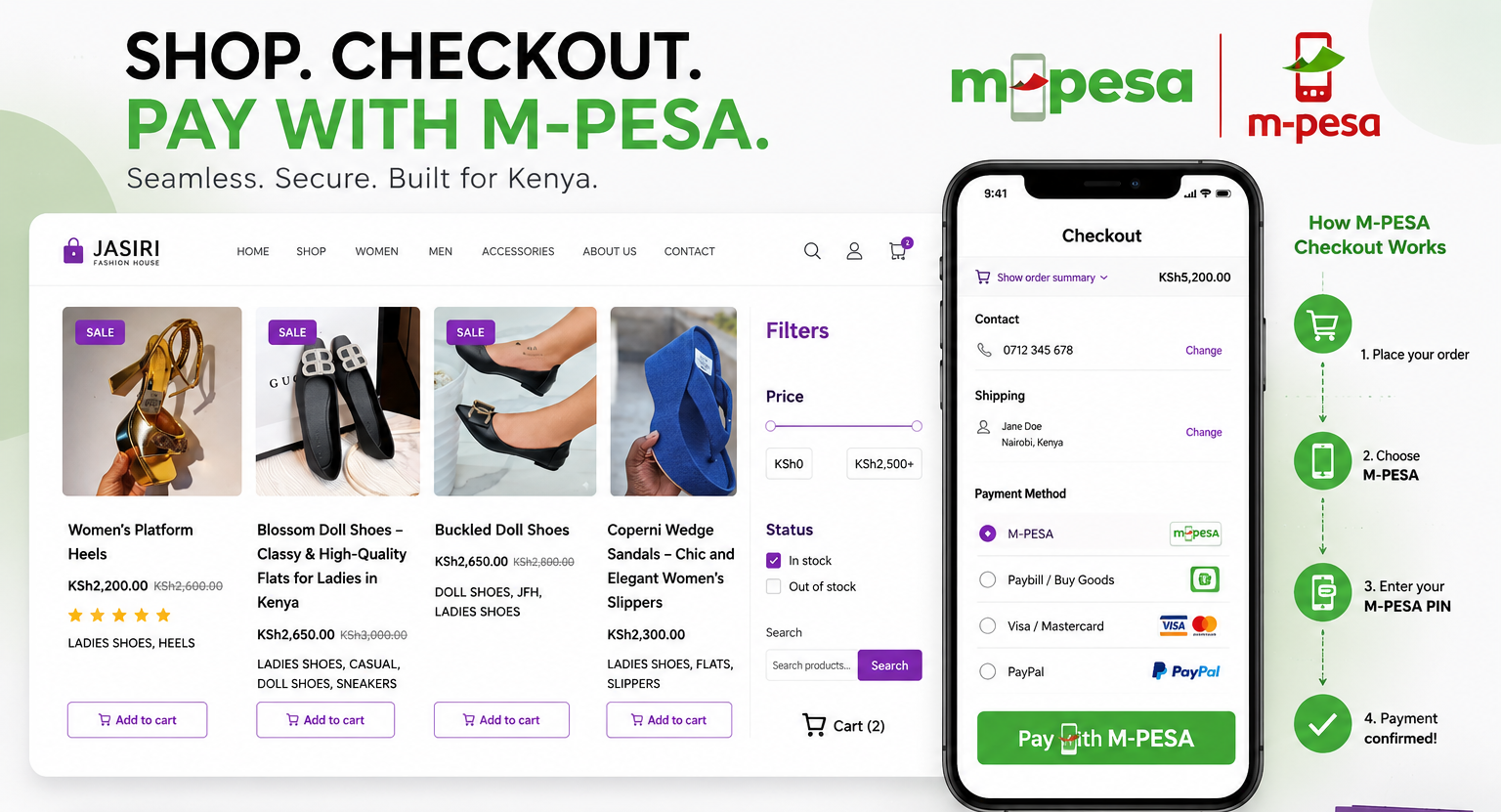
The demand for an e-commerce website in Kenya has grown rapidly over the past few years. More businesses are moving online, customers are becoming comfortable with digital shopping, and mobile payments continue to dominate the Kenyan economy. Today, whether you run a fashion shop, electronics business, cosmetics brand, supermarket, pharmacy, furniture store, or restaurant, having an e-commerce website is becoming essential for growth.
One of the most common questions Kenyan entrepreneurs ask is:
“How much do I need to create an e-commerce website with M-Pesa self checkout?”
The answer depends entirely on the type of business, the features required, the payment systems involved, and the marketing strategy behind the platform. In today’s AI-driven economy, an e-commerce website can cost anywhere from almost zero to over 30,000 KSh depending on complexity, integrations, automation, and visibility goals.
The biggest misconception in Kenya is that building an e-commerce website automatically guarantees sales. Many business owners pay for a website and stop there. Unfortunately, that is where the real problem begins.
Thousands of businesses in Kenya currently own:
- beautiful websites
- online shops
- WordPress stores
- M-Pesa checkout systems
but still experience:
- zero traffic
- zero visibility
- zero Google rankings
- zero leads
- zero conversions
Why?
Because most web designers focus only on development and fail to explain the importance of SEO, AIEO, Google Ads, Meta ads, and visibility strategies.
An e-commerce website without SEO is like opening a shop in the middle of a forest where nobody can find you.
This article explains:
- the real cost of an e-commerce website
- how M-Pesa integration works
- payment options available in Kenya
- hidden costs businesses ignore
- why SEO matters more than the website itself
- how AI is changing online commerce in Kenya
Why Every Business Needs an E-Commerce Website
Consumer behavior in Kenya has changed significantly. Customers now search online before making purchasing decisions. Even when buyers eventually purchase through WhatsApp or physical shops, the first impression often comes from Google, Instagram, TikTok, or an e-commerce website.
A professional e-commerce website allows customers to:
- browse products online
- compare prices
- pay instantly
- order anytime
- access your business 24/7
Unlike social media pages, an e-commerce website gives businesses complete control over branding, customer data, products, and marketing.
More importantly, integrating M-Pesa into an e-commerce website makes checkout easy for Kenyan customers who already trust mobile money systems.
The Importance of M-Pesa in Kenyan E-Commerce
No payment system is more important in Kenya than M-Pesa.
When building an e-commerce website, integrating M-Pesa is often the first priority because most Kenyan consumers prefer mobile money over cards or bank transfers.
An e-commerce website with M-Pesa allows customers to:
- pay instantly
- receive STK push prompts
- complete checkout quickly
- trust the payment process
Without M-Pesa, many Kenyan online shoppers abandon purchases before checkout.
That is why every serious e-commerce website in Kenya should support M-Pesa payments.
Payment Options for an E-Commerce Website in Kenya
Modern businesses should offer multiple payment methods because customers have different preferences.
1. M-Pesa STK Push
The most common payment option for an e-commerce website is M-Pesa STK push integration.
Customers simply:
- enter phone numbers
- receive prompts
- enter PIN
- confirm payment instantly
This creates a smooth customer experience.
2. Paybill and Buy Goods
An e-commerce website can also integrate:
- Paybill numbers
- Buy Goods Till numbers
This allows customers to pay directly through M-Pesa manually if needed.
3. WhatsApp Ordering
Many Kenyan businesses combine an e-commerce website with WhatsApp ordering.
Customers browse products online, then click:
“Order via WhatsApp.”
This works extremely well because Kenyan buyers trust WhatsApp communication.
4. USSD Checkout
Some businesses integrate USSD prompts into their e-commerce website for customers without smartphones or stable internet access.
This is especially useful for mass-market products.
5. Visa and Mastercard
An advanced e-commerce website should support:
- Visa
- Mastercard
- debit cards
- credit cards
This is important for:
- corporate clients
- international buyers
- diaspora customers
6. PayPal Integration
PayPal is useful for businesses targeting international audiences through their e-commerce website.
Although less common locally, PayPal still matters for:
- freelancers
- digital products
- international sales
How Much Does an E-Commerce Website Cost in Kenya?
There is no fixed amount.
The cost of an e-commerce website depends on:
- business goals
- design quality
- integrations
- SEO requirements
- payment systems
- AI features
In today’s AI era, businesses can technically create a simple e-commerce website for free using:
- Shopify trials
- AI website builders
- WordPress templates
- no-code platforms
However, professional businesses usually require advanced features.
Basic E-Commerce Website
A basic e-commerce website may include:
- homepage
- product pages
- shopping cart
- WhatsApp ordering
- basic M-Pesa integration
This works for:
- startups
- small boutiques
- beauty shops
- local stores
Advanced E-Commerce Website
An advanced e-commerce website may include:
- automated inventory
- AI chatbot support
- SEO optimization
- advanced analytics
- self-checkout systems
- M-Pesa STK push
- Paybill integration
- Visa and Mastercard support
- PayPal integration
This suits:
- supermarkets
- wholesalers
- pharmacies
- large online brands
The Biggest Mistake Kenyan Businesses Make
Many businesses spend money building an e-commerce website but completely ignore visibility.
This is the biggest problem in Kenya’s digital industry.
A business owner pays for:
- a WordPress site
- a shopping cart
- M-Pesa integration
- product uploads
but ignores:
- SEO
- AIEO
- Google indexing
- content marketing
- conversion optimization
As a result, the e-commerce website exists online but nobody can find it.
The business receives:
- no visitors
- no inquiries
- no sales
An e-commerce website without SEO is useless.
Why SEO Matters More Than the Website
SEO stands for Search Engine Optimization.
SEO helps your e-commerce website appear on Google when customers search for products.
For example:
- “best sneaker shop in Nairobi”
- “buy phones online Kenya”
- “fashion e-commerce website Kenya”
- “pay with M-Pesa online”
Without SEO, your e-commerce website becomes invisible.
This is one of the biggest mistakes web designers make in Kenya. Many developers deliver websites without optimizing:
- keywords
- product descriptions
- search structure
- mobile speed
- technical SEO
The client ends up with:
- a beautiful website
- working M-Pesa payments
- zero online presence
What Is AIEO?
AIEO means AI Engine Optimization.
As AI search tools become more common, businesses must optimize their e-commerce website for:
- conversational searches
- AI assistants
- semantic content
- structured information
The future of search is changing rapidly. Businesses ignoring AIEO may struggle to compete online.
Why WordPress Alone Is Not Enough
WordPress powers many Kenyan websites because it is flexible and affordable.
However, simply installing WordPress does not create a successful e-commerce website.
Many businesses think:
“Once my site is online, customers will automatically come.”
That is false.
A successful e-commerce website requires:
- SEO
- content marketing
- social proof
- Google Ads
- Meta ads
- fast performance
- trust-building
Without visibility, the site becomes an empty online shop.
Why Google Ads Matter
Google Ads help an e-commerce website appear instantly on search results.
For example:
If someone searches:
“buy laptops Nairobi”
Google Ads can place your e-commerce website at the top immediately.
This creates:
- targeted traffic
- product visibility
- faster conversions
- customer inquiries
Google Ads are especially important for new businesses trying to compete online.
Why Meta Ads Matter
Meta ads include:
- Facebook ads
- Instagram ads
- WhatsApp click ads
These ads help businesses promote products visually.
A successful e-commerce website usually combines:
- SEO
- Meta ads
- M-Pesa checkout
- retargeting campaigns
Without advertising, even a great website may struggle to grow.
AI Is Changing E-Commerce Websites
Artificial intelligence is transforming the way businesses build and manage an e-commerce website.
Today AI tools can help with:
- product descriptions
- customer support
- automated recommendations
- image generation
- chatbot responses
- SEO optimization
This reduces costs while improving efficiency.
That is why the cost of an e-commerce website now varies widely. Some businesses use AI to reduce expenses while others invest heavily in advanced automation.
Should Small Businesses Invest in an E-Commerce Website?
Absolutely.
Even small businesses benefit from having an e-commerce website because it:
- increases credibility
- improves visibility
- supports M-Pesa payments
- attracts customers online
- creates long-term growth opportunities
However, businesses must think beyond just launching the site.
The real question is:
“Can customers actually find the website?”
What Businesses Should Prioritize
When creating an e-commerce website, businesses should prioritize:
1. SEO
Without SEO, visibility disappears.
2. M-Pesa Integration
Every Kenyan online business should support M-Pesa payments.
3. Mobile Optimization
Most customers shop using smartphones.
4. Website Speed
Slow websites reduce sales.
5. AI Optimization
Future-proof your business for AI-driven search.
6. Marketing Strategy
Google Ads and Meta ads matter significantly.
7. Conversion Optimization
Your e-commerce website should encourage purchases naturally.
Final Thoughts
The cost of building an e-commerce website with M-Pesa self checkout in Kenya depends entirely on the type of business and the goals involved.
In today’s AI-powered economy, businesses can build an e-commerce website for almost nothing or invest over 30,000 KSh for advanced systems.
However, the most important lesson is this:
A website alone does not create sales.
Many Kenyan businesses build an e-commerce website, integrate M-Pesa, upload products, and expect customers to appear automatically. Unfortunately, that rarely happens.
Without:
- SEO
- AIEO
- Google Ads
- Meta advertising
- content marketing
- visibility strategies
an e-commerce website becomes invisible online.
The businesses winning in Kenya today are the ones combining:
- SEO
- AI optimization
- Meta ads
- Google Ads
- M-Pesa checkout
- customer trust
- fast mobile experiences
The future of online business in Kenya belongs to brands that understand both technology and visibility.
Because in ecommerce, visibility is everything.